Matt Igel
NSF Postdoctoral Fellow
I study the properties of tropical deep convective clouds at a process level. These clouds are a crucial component of tropical weather and climate. By improving our understanding of these clouds at a basic level, we will be able to improve our predictions of weather and climate in the tropics and around the globe.
I work with both observations and models. My observational work has focused on defining tropical convective signatures in CloudSat data and using these to assess simple length scales of these clouds. My modeling work has focused on the use of idealized, Radiative-Convective Equilibrium (RCE) models run at high cloud resolving scales.
For my postdoctoral fellowship, I am working with a model to assess the sensitivity of convective-rainfall criticality to various cloud processes.
See the "Publications" tab for more information
Recently I published a paper examining how influential various environmental/meteorological factors were to the size and shape of tropical deep convection. This figure is the primary result of those efforts. Ultimately it implies that troposphere-deep shear, the sea surface temperature, and aerosol are all important in dictating convective size and shape.
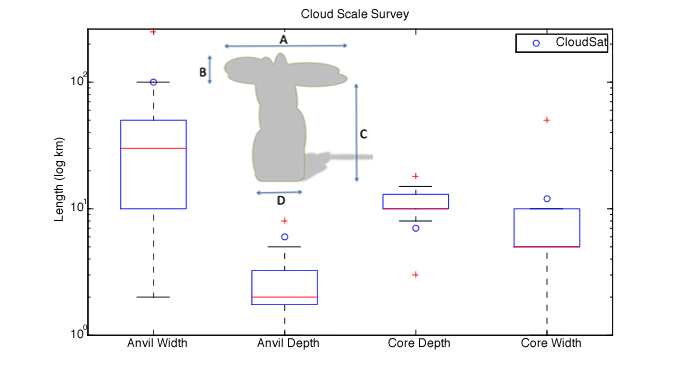
One of my goals in working with observations was to define an "average" cloud. The "average" cloud proved to be somewhat surprising. It turned out to be much wider and it's anvil much deeper that my initial hypothesis had supposed. These differences have interesting implications for how we think conceptually about deep convection.
Many responses and feedbacks between a warming climate and tropical deep convective anvils clouds have been proposed in the past (FAT, Thermostat, Iris). In one of my 2014 papers, I examined several of these responses and suggested that they may be a manifestation of a single response.